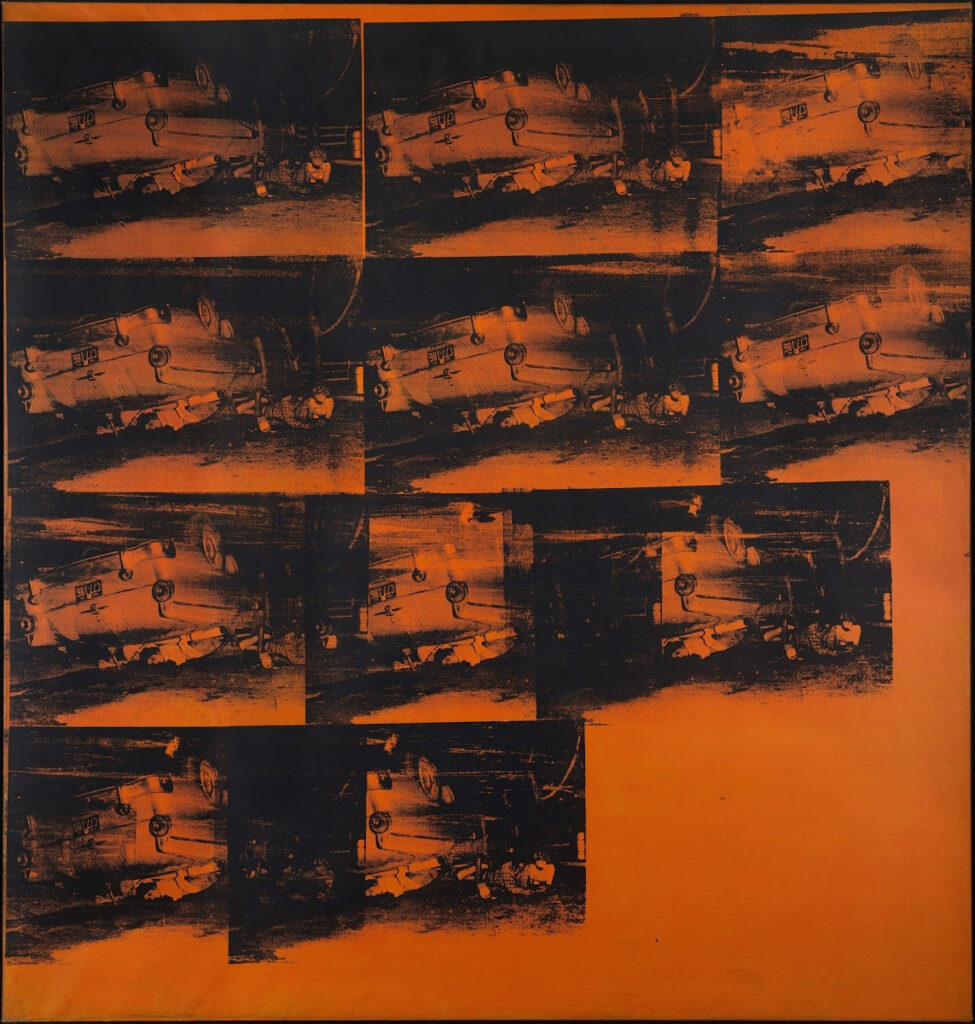
Andy Warhol, Orange Car Crash (5 Deaths 11 Times in Orange) (Orange Disaster), 1963
It is as a further result of his ability to travel in the supernatural worlds and to see the superhuman beings (gods, demons, spirits of the dead, etc.) that the shaman has been able to contribute decisively to the knowledge of death. In all probability many features of “funerary geography,” as well as some themes of the mythology of death, are the result of the ecstatic experiences of shamans. The lands that the shaman sees and the personages that he meets during his ecstatic journeys in the beyond are minutely described by the shaman himself, during or after his trance. The unknown and terrifying world of death assumes form, is organized in accordance with particular patterns; finally it displays a structure and, in course of time, becomes familiar and acceptable. In turn, the supernatural inhabitants of the world of death become visible; they show a form, display a personality, even a biography. Little by little the world of the dead becomes knowable, and death itself is evaluated primarily as a rite of passage to a spiritual mode of being. In the last analysis, the accounts of the shamans’ ecstatic journeys contribute to “spiritualizing” the world of the dead, at the same time that they enrich it with wondrous forms and figures.
—Mircea Eliade, Shamanism
In Warhol’s Disaster series, we encounter the radical de-spiritualization of death. The flat orange background showing through the transparent photographic reproductions arrests attention on the surface: the painting is formally and connotatively shallow. Repetition transforms the image into visual noise. The combination of black and burnt orange make it one the handsomest Disasters Warhol produced.
Warhol’s work conveys the profanation of the world by reproducing reproduction. This device has long since become a cliché and later appropriations, including Warhol’s own, are sterile iterations of an exhausted trope that stretch ironic depthlessness well-beyond its filmic range (which Duchamp had declared to be “infrathin”). That moment when art could put a frame around the banal came and went very quickly. It didn’t really last beyond the ’60s. What we start seeing emerging in the ’70s is what is in full effect today: the effort to re-moralize art by making it a platform for suburban liberal pieties, which has inexorably reduced contemporary art to the performative dimensions of a Twitter post.
Because we are immersed in the profane and cannot escape it, the only way to gain distance from it is to will it, momentarily indulging the illusion of authoring it.
In primitive man as in all human beings the desire to enter into contact wi!h the sacred is counteracted by the fear of being obliged to renounce the simple human condition and become a more or less pliant instrument for some manifestation of the sacred (gods, spirits, ancestors, etc.).
—Mircea Eliade, Shamanism
This is why every authentic prophet is a reluctant one.
Althusser does not know of this type of “interpellation,” because as a materialist he is preoccupied exclusively with material entities and material effects. The beyond of the material, the metaphysical, is to him foreclosed and his world is circumscribed by authority, ideology, and subjugation.
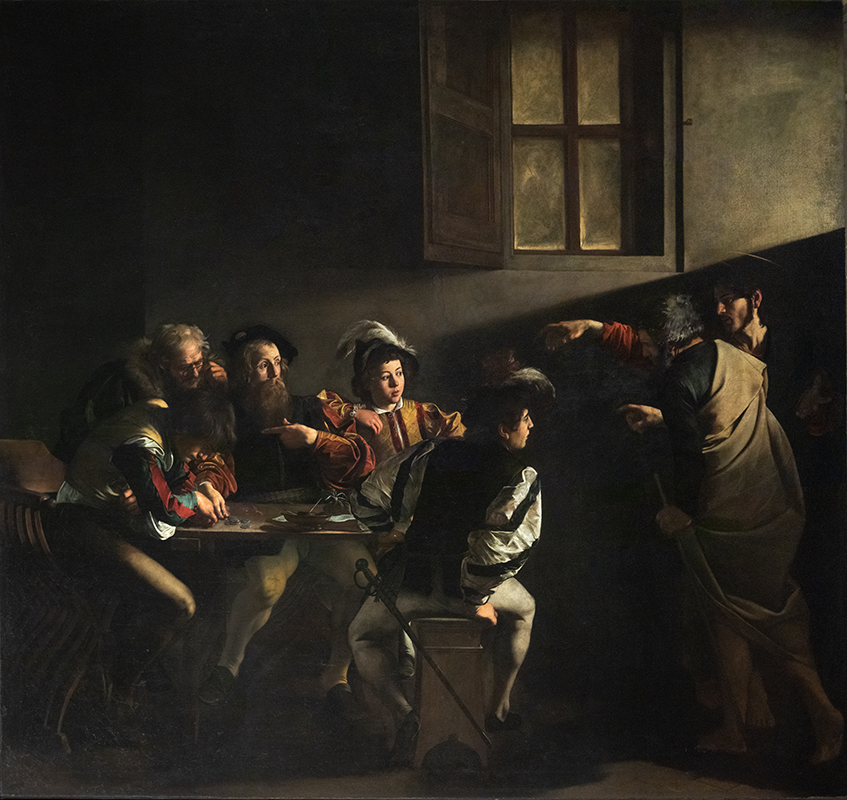
And yet, in so many instances where authority has been challenged, the conviction and strength that sustained the challenge have come from belief in a higher, unworldly authority. Ordinary mortals become superhuman because they are drawn to something that is immaterial, to something that is not of this world and to which they feel a greater loyalty than to the powers that rule this world. So it is that in answering Jesus’ call, St. Matthew begins a journey to martyrdom (depicted by Caravaggio on the wall of the Contarelli Chapel opposite The Calling),which he incurs because he dares to rebuke a king.
One of the most tenacious of the typically modern prejudices is the one that sets itself up against the impersonal and objective rules of an art, for fear that they should stifle creative genius. In reality no work exists that is traditional, and therefore “bound” by changeless principles, which does not give sensible expression to a certain creative joy of the soul; whereas modem individualism has produced, apart from a few works of genius which are nevertheless spiritually barren, all the ugliness—the endless and despairing ugliness—of the forms which permeate the “ordinary life” of our times.
“Initiation usually comprises a threefold revelation of the sacred, of death, and of sexuality.” (Mircea Eliade, The Sacred and the Profane)The initiate emerges from the initiating mysteries as one who knows.
The symbolism of death and (re)birth figures prominently in these mysteries. The initiatory ordeals impress upon initiates the import of coming to age and gaining admission into a society of recognized adults. The painful ordeals make the passage an indelible experience but also convey the existential weight of the secret knowledge that is revealed to the initiate. Knowledge of what is vital is knowledge of pain but also knowledge of the ability to surmount pain and deprivation. Thus the initiate gains both self-confidence and pride in tribal fellowship. The necessary subjugation that forges fully formed subjects is not left to chance.
In a desacralized society, the symbolism of death and birth is unavailable, as is symbolism in general, and rites of passage no longer exist. This leaves each individual to “choose” his or her own identity, now extended to the right of each individual to declare their gender identity. Because these identities are self-conferred with no travail they carry little weight and are as easily cast off as they are put on. Under these circumstances, identity never amounts to anything more than an attitude and one never attains the position of one who knows. One remains a perpetual infant, not to say an embryo, arrested in a lifelong condition of insecure identity, anxiety, and bewilderment. The young are formally enjoined to “grow up” but they are immersed in a disorder that they do not have the means to escape. Their “rights” confine them for a lifetime in a larval stage of boundless but never realized potential.
Religious man conquers the fear of death and acquires the ability to live fully and authentically by assigning death the symbolic meaning of passage: initiation kills the profane and unformed man, who is then reborn as consecrated man, free from the fear of death and, therefore, enabled to live a noble life. Uninitiated, irreligious man shrinks from death and is, therefore, condemned to live a cowardly, compromised, senseless half-life.
This has bearing on why the West is at war with itself and takes pride in demolishing its own traditions, canons, and monuments. A desacralized and diminished civilization cannot tolerate the memory of its sacred origin. The legacy of the past becomes an embarrassing encumbrance putting to shame the spiritual poverty of the present. But the willful erasure of the past does not prevent it from haunting the present. The sacred persists as a haunting, as the always possible undoing of “progress.”
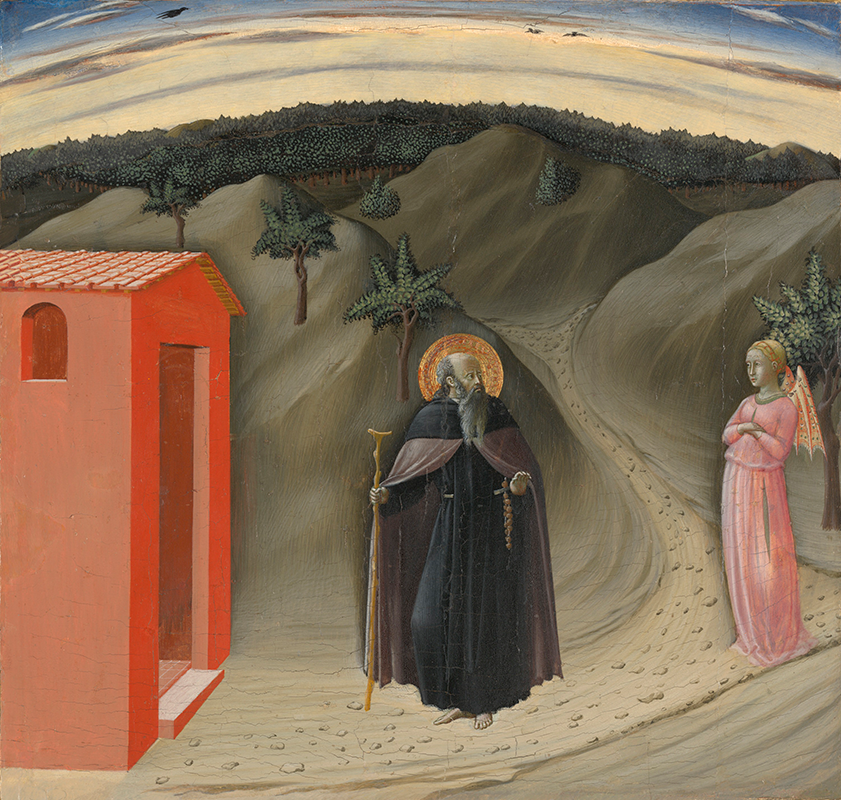
Master of the Osservanza, Saint Anthony Abbot Tempted by the Devil in the Guise of a Woman, c. 1440
Most of the art-historical literature from the 20th century that addresses Italian Renaissance painting follows a much earlier tradition according little respect to the early schools. Many writers still perpetuate the hierarchical construction of artistic development during the Renaissance that Giorgio Vasari expounded in his Lives of the Artists (1550 and 1568), which was the most influential discussion of the history of Italian Renaissance art. In the three prefaces that frame the chronological sequence of the lives of the great Italian artists, Vasari presented a view of the progressive development of art that appears remarkably biased in hindsight. As Erwin Panofsky explained in an essay of 1930, Vasari reestablished the supremacy of the classical style during the High Renaissance by tracing its emergence from a constructed antithesis: the primitive Gothic past. Vasari outlines a model of artistic progress through quasi-biological cycles of development and renewal. He draws on the idea often expressed by classical historigraphers that the evolution of a state or culture corresponds to the ages of man. There was the cycle of ancient times that reached its peak in the Golden Age of classical Rome, after which art declined and then virtually disappeared during the darkness of the early Middle Ages. But then, as the Renaissance gradually dawned, a second cycle began. According to Vasari, the cycle of the Renaissance developed toward its zenith in three stages or ages, compared metaphorically with infancy and childhood, adolescence, and adulthood or maturity.
The first age, or childhood, began with the appearance in the late 13th century in Tuscany of talented artists including Cimabue and, most significantly, Giotto. Vasari describes these childlike artists as eventually “weaned” and brought up beyond the stage of infancy. Through increased study of nature, the arts then climbed to a second age, or adolescence, in the 15th century, exemplified by Masaccio and Donatello. Finally, by turning not only to nature but also to the ancients, and by striving not just to equal but to surpass them both, the arts arrived at a second Golden Age during the early 16th century in Florence and Rome. Vasari believed that absolute perfection was embodied in the art of the divine Michelangelo, and to a lesser degree in Leonardo and Raphael.
This construction of the development of Italian Renaissance art continues to hold sway. It reached us with the help of Heinrich Wölfflin’s often-reprinted Die Klassische Kunst or Classic Art of 1899 and 1903, in which Vasari’s concept of artistic progress is given fuller stylistic description and also associated with notions of class. For example, Wölfflin conceives of the transition from 15th-century to High Renaissance painting as a movement from “a bourgeois art” to “an aristocratic one.” Domenico Ghirlandaio’s Birth of St. John the Baptist of 1485, in Sta. Maria Novella in Florence, presents fussily detailed settings with many overtly gesturing figures in a manner suited to “middle-class” tastes. By contrast, Andrea del Sarto’s Birth of the Virgin of 1514, in the forecourt of SS. Annunziata in Florence, is noble, elevated, dignified, and “aristocratic”. Like Vasari, Wölfflin glorifies the High Renaissance by denigrating that which came before.
The early Italian artists of the late 13th and 14th centuries were, accordingly, often seen to be lower class. In fact, Vasari’s metaphor of childhood was translated into a conception of these artists as simplistic and, therefore, primitive. As the enduring label i primitivi suggests, they were associated with a complex mixture of other “primitive” artists from as yet infantile or uncivilized, typically non-Western cultures. In turn, the childlike simplicity seen in their art could be interpreted negatively, as reflecting an ignorance of learned conventions and, therefore, as naïve and rude, although in some instances the freedom from learned conventions was viewed more positively as unaffectedly truthful and unconsciously expressive. Several decades before Wölfflin’s discussion of High Renaissance style, Charles Eastlake, then director of the National Gallery of London, explained, in this negatively charged way, the inclusion of some very early Tuscan panels as part of a larger purchase of paintings from the Lombardi-Baldi Collection:
The unsightly specimens of Margaritone and the earliest Tuscan painters were selected solely for their historical importance, and as showing the rude beginnings from which, through nearly two centuries and a half, Italian art slowly advanced to the period of Raphael and his contemporaries.
Even the members of mid-19th-century purist movements essentially followed Vasari’s model, though they assessed the simplicity of the early Italian painters quite positively. Tommaso Minardi, the most active Italian advocate of purism, elevated Giotto’s art—believing the Assisi frescoes to be by Giotto—because of the natural simplicity and intensity of expression. He was then compelled to heap even greater praise on the artists of “the period of highest rewards, the period of perfection”.
Painters from various centers in Italy, working in the period ca. 1180–1400 or even later, were known collectively as the “primitives” as late as the 1970s; this fact reveals much about prevailing attitudes toward early Italian art. The label “primitive,” with its dual associations of “rude” and “unconsciously natural,” set the early schools apart as different and less polished than “classic” artists. But the implicit contrast was there: these distinctive, rare, and often exquisitely crafted paintings, instead of being appreciated on their own terms, were devalued through a historical comparison with the muscular superrealism of Michelangelo or the robust idealized figures and soft landscapes of Raphael. Vasari’s notions of High Renaissance classicism, subsequently elaborated upon in the definition of “fine art” within the French academic tradition, formed the enduring touchstone of artistic perfection against which early Italian painting was measured and was consequently found lacking. Indeed, the post-World War II literature continues the currency of expressions such as “the dawn of Italian painting,” thus perpetuating the belief that these works represent the earliest stages in the artistic evolution that produced the high noon of the High Renaissance. Alistair Smart chose that image of the dawn for the title of his early Italian survey, first published in 1978, and elaborated on the analogy in his poetic introduction:
The glow of dawn leads on to the blaze of noon, but its quality is quite distinct. And if the full light of Renaissance painting can be likened to a noonday amenable to the objective scrutiny of the natural world, the rise of the early Italian Schools suggests, rather, a slow dawn whose spreading light, while gradually revealing the forms of things, retains its mystery.
Although Smart celebrates what he sees as the distinctly mysterious or otherworldly quality of early Italian painting, the metaphor of the rising sun betrays his acceptance of Vasari’s paradigm.
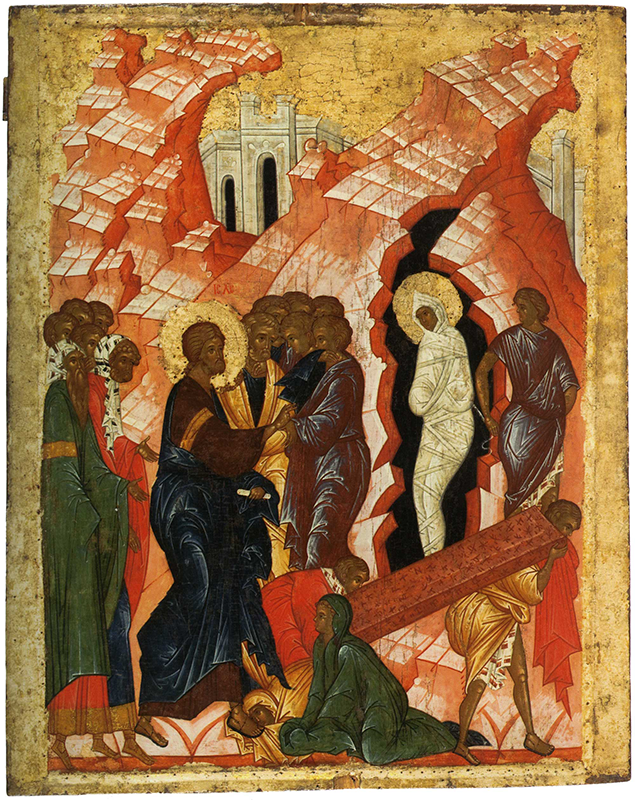
Or why it is not because they lack technical facility that the painters of medieval icons appear uninterested in getting perspective “right.” Rather because like all artists whose concern is with “noumenal” (as opposed to phenomenal) space, they want to force a visual rupture with mimetic representation.
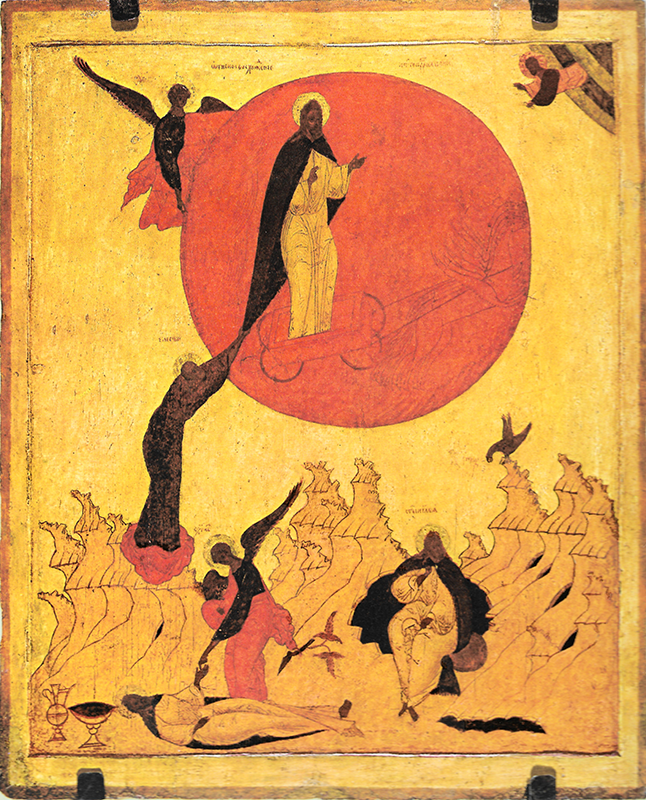
Semantically important gestures and objects, as a rule, are presented in close-up shots, a departure from the laws of linear perspective. This may be seen in the Archangel Gabriel’s gesture of blessing in icons of the Annunciation, or images of the scroll St John of Damascus holds in medieval Russian O Tebe raduyetsya [In You Rejoices] icons, with the opening words of the hymn in honour of the Mother of God. This emphasis shows that the text of the song composed by St John of Damascus was at the very heart of the icon’s composition. The same may be said of depictions of the outer clothing (the “mantle”) which the prophet Elijah leaves to his disciple Elisha on icons of the Ognennoye vozneseniye Ilyi Proroka [Fiery Ascent of the Prophet Elijah]. The materiality and the miraculous power of the “mantle” turns it into the central device of the composition, uniting heaven and earth.
The Fiery Ascent of the Prophet Elijah (16th century), State Historical Museum, Moscow
[Pavel] Florenskii also linked the absence of shadows in the artistic space of the icon with the system of reverse perspective: “The absence of a definite focus of light, the contradictory nature of illumination in different places of the icon, the effort to bring forward masses which should have been overshadowed–yet again, this is neither coincidence nor a blunder by a naive craftsman, but artistic calculation, which imparts maximum artistic expressiveness.” Florenskii clearly follows Plato and his symbol of the Cave in the determination of people’s knowledge, since, in his works, light and shade acquire gnoseological meaning in the context of the metaphysics of reverse perspective. Platonic Ideas are “shadows,” “the negative of things,” “intaglio experiences;” a turn towards the light is a transition to a new level of cognition, and symbolizes our drawing closer to the truth. From any viewpoint, therefore, iconic images exclude shadow; when perceiving inscriptions, figures, architecture and landscape depicted on the icon, a turn (which also suggests a mobile gaze) may well convey gnoseological meaning. The icon is a transfigured reality, which knows no shadow.
Art originated as a means of representing the sacred. It originated to make visible what cannot be seen, to represent what is unrepresentable.
As long as art served the sacred, it had purpose and vitality.
The modern profanation of life and society left art flailing for a purpose. Oscar Wilde went so far as to declare the uselessness of art to be its distinguishing virtue. He was forced to do so to safeguard art from serving an even viler purpose, the worship of money. But art was not content to be useless and has since been driven to stage its own degradation as its purpose, incorporating into itself everything that was once foreign to it: ugliness, banality, artlessness, blasphemy.
In this fallen world, the pull of the sacred lingers as an inclination toward the abyss. The closest to sacred art today is art that expresses a longing for self-extinction. What comes to mind is music that inspires trance and abandon.
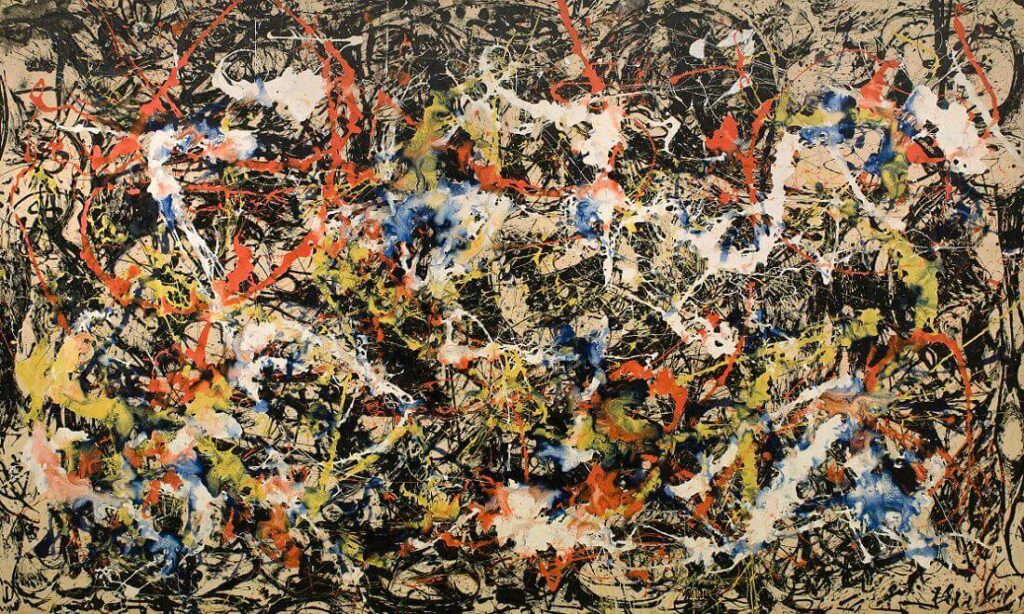
In visual art, the ecstatic is misidentified as “expressionism,” but the truly ecstatic art is always about the obliteration of the self not its expression.
Marx’s hatred of modernity is, I think, insufficiently appreciated.
“Everything solid melts into air, everything holy is profaned . . .” he declared in the Communist Manifesto.
No contemporary conservative mindlessly prattling on about the toxicity of “cultural Marxism” can fathom the revulsion against modernity that colors Marx’s writing from beginning to end.
The idea of a Hegelian Aufhebung that would, like the monster in Alien, burst capitalism from within and usher in a latent communism was just cope. Marx became a revolutionary because he lacked the courage to be a reactionary. He found in Hegel a means to invert pessimism into a synthetic—one might say almost manic—faith in the inevitability of communism and through communism, the restoration of the world.
For Marx the proletariat is the golem, an inert mass with the potential to become an avenging monster when it acquires (class) consciousness and changes from an “in itself” to a “for itself.”
The anti-bourgeois, anti-liberal, and ultimately, antimodern orientation of Marxism hidden beneath its revolutionary rhetoric helps explain how communism protected the societies in which it was victorious from the worst consequences of modernity, for ultimately communism quarantined these societies from consumerism’s relentless liquidation of tradition. And this is why even after the dismantling of the old Stalinist systems, the decadent and now economically and culturally senescent West has not lost any of its antipathy for the East.