Capital

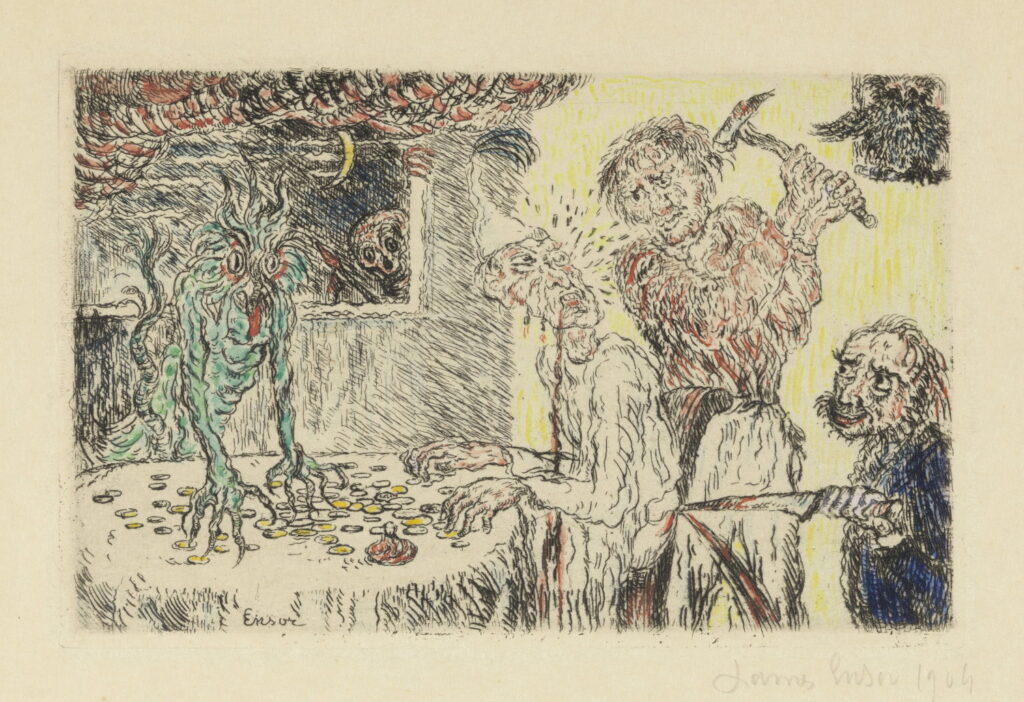
James Ensor, Seven Deadly Sins, Avarice, 1904

The rules of money are precise and invariable. Money attracts money, money seeks to accumulate in the same places, money is naturally attracted to scoundrels and those who are entirely bereft of any talent. When, by an exception which proves the rule, money finds its way into the hands of a man who, though wealthy, is neither a miser nor has any murderous proclivities, it stands idle, incapable of creating a force for good, incapable of even making its way into charitable hands who would know how to employ it. One might almost say that it takes revenge for its misdirection, that it undergoes a voluntary paralysis whenever it enters into the possession of someone who is neither a born swindler nor a complete and utter dotard.

When, by some extraordinary chance, it strays into the home of a poor man, money behaves even more inexplicably. It defiles immediately what was clean, transforms even the chastest pauper into a monster of unbridled lust and, acting simultaneously on the body and the soul, instils in its possessor a base egoism, not to mention an overweening pride, which insists that he spends every penny on himself alone; it makes even the humblest arrogant, and turns the generous person into a skinflint. In one second, it changes every habit, upsets every idea, transforms the most deep-seated passions. ‘

Money is the greatest nutrient imaginable for sins of the worst kind, which in a sense it aids and abets. If one of the custodians of wealth so forgets himself as to bestow a boon or make a donation, it immediately gives rise to hatred in the breast of the recipient; by replacing avarice with ingratitude, the equilibrium is established again: a new sin is commissioned by every good deed which is committed.

But the real height of monstrosity is attained when money, hiding the splendour of its name under the dark veil of the word, calls itself capital. At that moment its action is no longer limited to individual incitations to theft and murder, but extends across the entire human race. With a single word capital grants monopolies, erects banks, corners markets, changes people’s lives, is capable of causing millions to starve to death. And all the while that it does this, money is feeding on itself, growing fat and breeding in a bank vault; and the Two Worlds worship it on bended knee, melting with desire before it, as before a God.

J.-K. Huysmans, Lá-Bas
Belles Lettres

In his experience, writers belonged to one of two classes: the unspeakably rapacious or the unspeakably ill-mannered.

The first group consisted of the public’s favourites and, though corrupted by their popularity, there was no doubting they had arrived. Ever in need of more attention, they imitated the ways of big business, rejoiced in gala dinners, hosted evening parties, spoke of copyrights, sales figures and box office receipts, and generally proclaimed their prosperity.

The second group was made up of the dregs of society, the flotsam and jetsam of the capital’s bars and cheap watering-holes. There they vaunted their inferior wares, full of self-loathing as they did so, gave free range to their particular form of genius and vented their spleen, while all the time lolling around on benches, pouring beer down their gullets.

No intermediate state existed between the promiscuity of the overcrowded cafes and that of the drawing-room, both offering boundless opportunity for gossip and back-stabbing. Places where one could meet and chat intimately, exchange ideas with a few like-minded artists, untroubled by the presence of women, had almost ceased to exist.

In short, no aristocracy of the soul existed in the world of letters; no view was ever expressed which might provoke consternation; no sudden, breathtaking flight of fancy was ever allowed. The conversations which occurred were the same ones every night whether they occurred in the rue du Sentier or the rue Cujas.

—J.-K. Huysmans, Lá-Bas

The Exemplary Hugo Ball

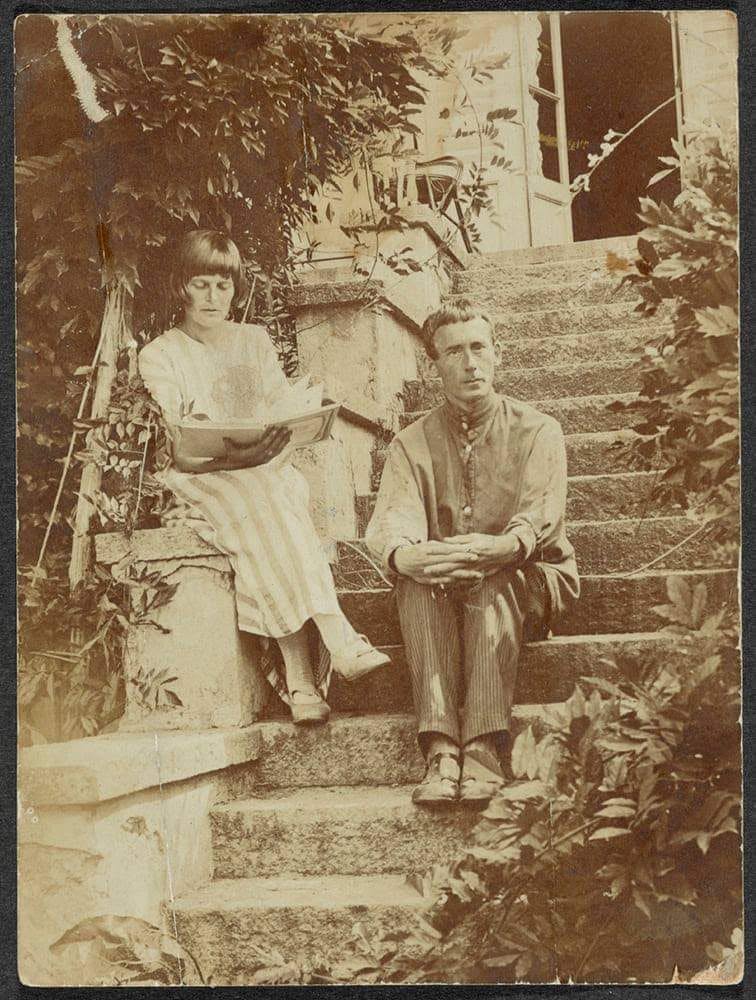
Most of the figures who were involved in Dada proved to be opportunists who for all their anti-art fervor never had any intention of abandoning art and went back to it the minute they could profitably resume their careers. The exception was Hugo Ball, who after the war resigned from the avant-garde, retired to a small Swiss village with Emily Hennings, reconverted to Catholicism and spent the last years of his short life “writing about early Christian saints, Byzantine spirituality, and theology.”

Shitshow

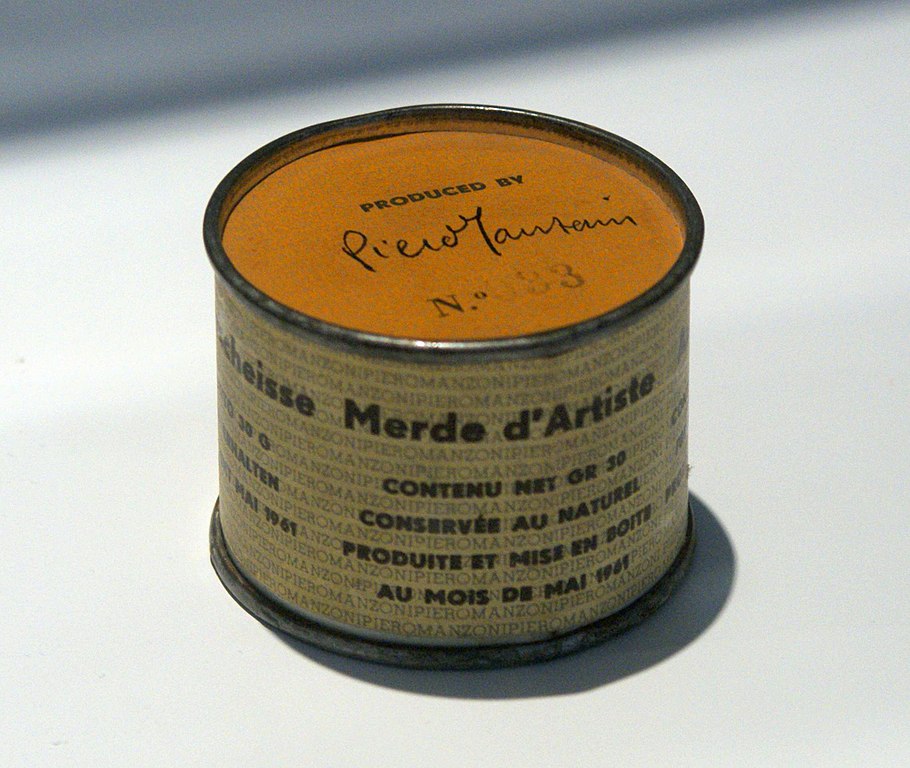
Piero Manzoni, Artist’s Shit, 1961

Consciousness of a real and meaningful world is intimately connected with the discovery of the sacred. Through experience of the sacred, the human mind has perceived the difference between what reveals itself as being real, powerful, rich, and meaningful and what lacks these qualities, that is, the chaotic and dangerous flux of things, their fortuitous and senseless appearances and disappearances. . . . In short, the ” sacred” is an element in the structure of consciousness and not a stage in the history of consciousness. On the most archaic levels of culture, living, considered as being human, is in itself a religious act, for food-getting, sexual life, and work have a sacramental value. In other words, to be—or, rather, to become—a man signifies being “religious.”

—Mircea Eliade, A History of Religious Ideas

Art has always served power but in the premodern period, power, though associated with wealth, was not its product. Modern power, however, is wholly the power of capital. And the power of capital, unlike the power of nobility or the power of the sacred, is a power that art is hard-pressed to exalt.

Thus, the real story of modern art, once one gets past the self-heroicizing bluster of the avant-garde, is the story of the difficulties that had to be surmounted before art could be sufficiently debased to serve capital.

For art to serve capital, it had to develop the means to make grossness glamorous.

What is grossness? It is the transactional liquidation of all discrimination. This is the enormity that modernity introduced into the aesthetic field, this radical relativization imported into art from the logic of a capitalism that does not recognize any value other than the monetary. Once this idea prevails, the banality of contingency invades both life and art. Grossness is the excrementalizing effect of contingency, the homogenization into waste production of all production since under this regime where all value is determined by price and nothing is of intrinsic value, all meaning is fugitive and provisional and every object and idea disposable.

In this context, the artistic “subversion” of established aesthetic norms and standards is actually a coping mechanism because it is an effort to will the inevitable, to give to what has already happened and is irreversible the appearance of a deliberate “progressive” ground-breaking innovation.

Modern (and postmodern) blasphemous artistic gestures merely perform as willful activism a dismantling of categories that have already been fatally destabilized, already invaded and devoured by the dissolving power of capital, which as Marx had wryly observed in his early writings makes possible “the fraternisation of impossibilities.”

Art in the service of capital is art in the service of shit or what Clement Greenberg politely called kitsch.

The avant-garde rationalized this submission of art to the excrementalizing exigencies of capital by giving it the cover of a programmatic unification of art and “life.”

But what precisely did this unification of art and life entail?

In 1969, on the occasion of the seminal exhibition Live In Your Head: When Attitudes Become Form, Scott Burton blurted out the implications: “Art has been veritably invaded by life,” he declared, “if life means flux, change, chance, time, unpredictability.” Left unsaid was that life comes to mean flux, change, chance, time, and unpredictability only when it has been thoroughly profaned and reduced to mere existence, that is to say when life has become senseless.

So the invasion of art by life comes to mean from the late ’60s onward the transformation of art into a mirror of all the self-perpetuating afflictions of a senseless life: the manic novelty seeking, the compulsive posturing, the pity partying, the attitudinizing, the politicization of trivialities, the simultaneous solicitation of outrage and affirmation, the obsessive preoccupation with identity and its precious signifiers.

The shitshow that is late capitalism is no longer hidden from view. Art doesn’t attempt to offer a refuge from it. It ironicizes it and puts it behind an almost imperceptible transparent wall. Everything becomes a readymade and to that extent, everything becomes a work of art toward which we assume, as Duchamp did, a studied or affected indifference. This is how art serves power today, not by aggrandizing it but by putting a stupid smirk on our faces.

Lisp Press

Lisp Press, which I founded in 2011 to publish my own artist books will, over the course of the summer, transition to publisher of Decadent and Symbolist literature and criticism. I will announce titles as they become available. The first scheduled is Arthur Machen’s The Hill of Dreams.

Scroll to Top