The Impossibility of a Materialist Art

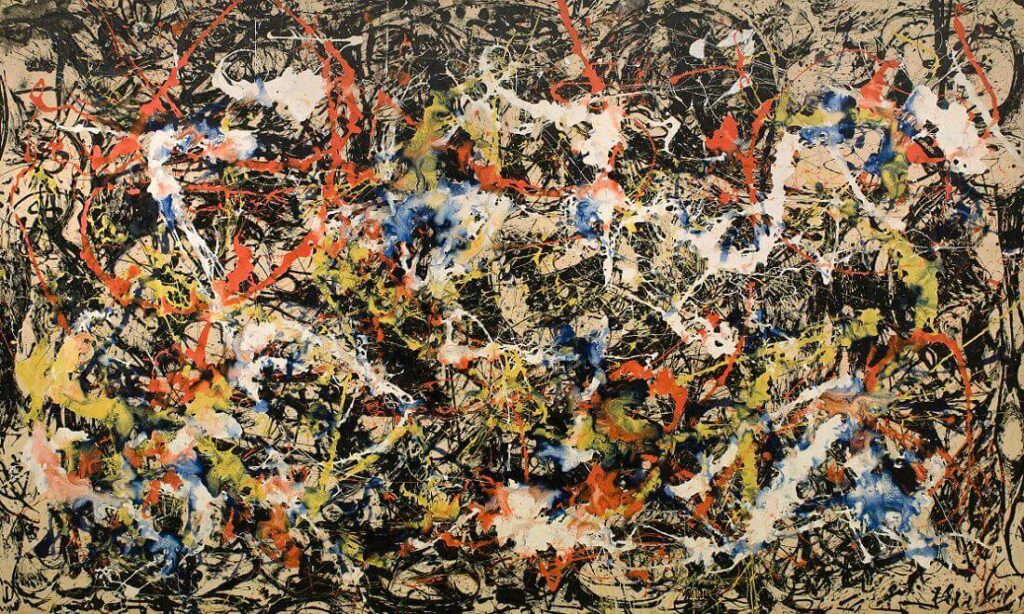
The progressive antipathy for religiosity shows up in modern art as hatred of “illusionism.” It is a hatred that drives modern art toward abstraction and a fixation on the materiality of the signifier.

But art can never become totally materialist, can never be reduced to objecthood, because if it is, it ceases to have a symbolic function and without symbolic function, it ceases to be distinguishable as art.

So an art that seeks to eradicate all illusionism must eventually eradicate itself. And we get very close to this with the readymade. But not quite, because the readymade, whether considered as art or antiart art, still invokes the symbolic. Duchamp’s urinal is no longer just a urinal once it is “nominated” as art. This nomination bears uncanny resemblance to the consecration of the profane object, which likewise may retain the external appearance of a quite ordinary object (stone, tree, pool, bread, wine, etc.) and yet be imbued with unearthly power. It is only in an art history dissociated from the larger history of human ritual that the invention of the readymade is assigned such disproportionate significance. The readymade is a parody of the consecrated object.

The readymade shares with the “literal” minimalist object the sleight of hand of invoking the metaphysical while pretending to abolish it. So Fried’s rejection of literalism in “Art and Objecthood” was well-founded. The idea that wants to come to the surface in that tortured and verbose essay is that art is art only to the extent that it serves a metaphysical purpose. Art is the transfiguration of matter into symbol. And this and this alone is the reason why art cannot be reduced to a dumb, profane object without ceasing to be art. Fried could not bring himself to state this and in failing to state it he revealed why formalism, which for a period served as a bulwark against the banalization of art, finally failed at its task and left the field to be trampled by the postmodernist hordes.

The Birth of Formalism

Art is useless because its aim is simply to create a mood. It is not meant to instruct, or to influence action in any way. It is superbly sterile, and the note of its pleasure is sterility. If the contemplation of a work of art is followed by activity of any kind, the work is either of a very second-rate order, or the spectator has failed to realise the complete artistic impression.

A work of art is useless as a flower is useless. A flower blossoms for its own joy. We gain a moment of joy by looking at it. That is all that is to be said about our relations to flowers. Of course man may sell the flower, and so make it useful to him, but this has nothing to do with the flower. It is not part of its essence. It is accidental. It is a misuse. All this is I fear very obscure. But the subject is a long one.

Oscar Wilde, Letter to Bernulf Clegg

What hides under Wilde’s assertion that art is useless and “superbly sterile” ?

Well, for one thing, a hint of his sexual orientation. But that is a trivial thing. 

In the late 19th century, aestheticism and “art for art’s sake” become a means to defend art against its crude bourgeois instrumentalization. The declaration of art’s uselessness flies in the face of the prevailing utilitarianism. But this defense is already a compromise. From service to the sacred, for which no space remained in the modern world, art retreats into “uselessness,” so as to at least resist the grosser demands of middle class taste. Because the sacred has been dispossessed of value, its vestigial presence in art can only be upheld by a fetishization of art’s uselessness, i.e. its material uselessness.

Clive Bell’s theory of significant form was more perspicacious than Wilde’s. Bell understood that form has metaphysical significance:

Significant form stands charged with the power to provoke aesthetic emotion in anyone capable of feeling it. The ideas of men go buzz and die like gnats; men change their institutions and their customs as they change their coats; the intellectual triumphs of one age are the follies of another; only great art remains stable and unobscure. Great art remains stable and unobscure because the feelings that it awakens are independent of time and place, because its kingdom is not of this world. To those who have and hold a sense of the significance of form what does it matter whether the forms that move them were created in Paris the day before yesterday or in Babylon fifty centuries ago? The forms of art are inexhaustible; but all lead by the same road of aesthetic emotion to the same world of aesthetic ecstasy. 

In Bell’s words, there is an indication that in its infancy, formalism was not the sterile thing it became after Clement Greenberg got a hold of it. Greenberg advanced formalism by reformulating it as a technocratic procedure for “entrenching” each art medium in its “area of competency.” Rigorous formal autocritique was supposed to safeguard art from assimilation into kitsch. In actuality, this microscopic narrowing of focus ensured the complete desacralization of abstraction and, inevitably, its banalization.  This is evident in the utter vacuity of Frank Stella’s postminimalist output, the precursor of most contemporary abstraction.

Nothing hastened the transformation of abstraction itself into kitsch than Greenberg’s effort to remove from abstraction any suggestion of something beyond form.

The Readymade as Fetish

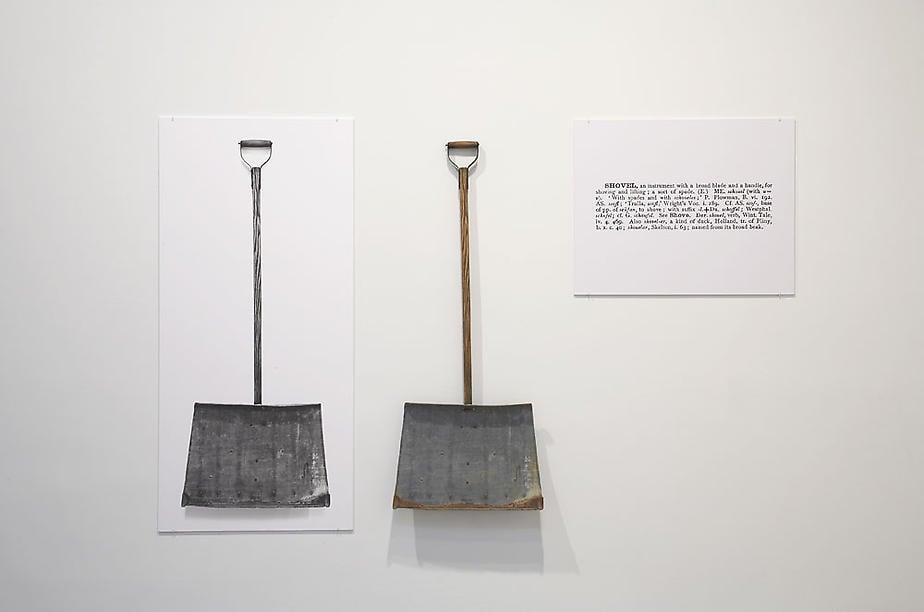
Joseph Kosuth, One and Three Shovels, 1965

Let us summarily dismiss the idea propagated by critics eager to pander to the liberal arty farty elite’s democratic pretensions that Duchamp “nominating” a urinal to the status of art object is a gesture of “inclusion.” No. Fountain’s significance is the exact opposite: If it challenges the distinction between art and nonart, it is only to make that distinction explicitly and exclusively institutionally authorized. The seemingly arbitrary inclusion of select ordinary objects into the pantheon of art formalizes the authority of a collaboration between the nominator and the elite institutional framework that ratifies these nominations. There is no dismantling of boundaries, no levelling of “high” and “low.” Instead, the readymade makes flagrant the obduracy of that hierarchy. A urinal is something to piss on. Fountain is a museum piece. You couldn’t find a more brazen demonstration of the cultural hegemony of the bourgeoisie than that.

Through its seemingly miraculous ability to author vacancy, the readymade gilds everything it absorbs into itself with an “infrathin” aura that permits the banal to be consumed as the ironic. The readymade is a fetish. It intervenes as the last barrier to the recognition of the insufferable hideousness of an encroaching, engulfing banality. In lieu of a passive surrender to banality, the readymade delivers the spectacle of banality’s active embrace. The readymade is the paradoxical phallicization of flaccidity and impotence.

But the readymade also grudgingly hints at a recognition that the most complex and engaging forms in the modern world are consumer products. In other words, it hints at the untenability of the modern distinction between things of use and things of aesthetic value. But it does so by hiding the usefulness of things like urinals and snow shovels behind or underneath the ritual of their (redundant) art-ification. In theory, the readymade invites a dismissal of the very notion of  art. In practice, it functions as the artistic equivalent of transubtantiation.

Once we understand this, we can appreciate the value of the readymade within the libidinal economy of capitalism. The problem is that the very profusion of the dazzling forms with which capitalism gluts the world renders them invisible. This is what Benjamin was getting at with his notion of aura and its loss through reproducibility. Standardization and mass production rob the object of its quiddity, turn it into something that passes through our hands too quickly, too unobtrusively. The readymade enables a slower mode of consumption, a more deliberate enjoyment of the act of acquisition. It permits an appreciation of the substantiality of the disposable object.

Viewed this way, the readymade is not an attack on art. It is not antiart. It is rather the last artistic means that modernity can muster to stave off disenchantment.

Scroll to Top