Disaster
It is as a further result of his ability to travel in the supernatural worlds and to see the superhuman beings (gods, demons, spirits of the dead, etc.) that the shaman has been able to contribute decisively to the knowledge of death. In all probability many features of “funerary geography,” as well as some themes of the mythology of death, are the result of the ecstatic experiences of shamans. The lands that the shaman sees and the personages that he meets during his ecstatic journeys in the beyond are minutely described by the shaman himself, during or after his trance. The unknown and terrifying world of death assumes form, is organized in accordance with particular patterns; finally it displays a structure and, in course of time, becomes familiar and acceptable. In turn, the supernatural inhabitants of the world of death become visible; they show a form, display a personality, even a biography. Little by little the world of the dead becomes knowable, and death itself is evaluated primarily as a rite of passage to a spiritual mode of being. In the last analysis, the accounts of the shamans’ ecstatic journeys contribute to “spiritualizing” the world of the dead, at the same time that they enrich it with wondrous forms and figures.
—Mircea Eliade, Shamanism
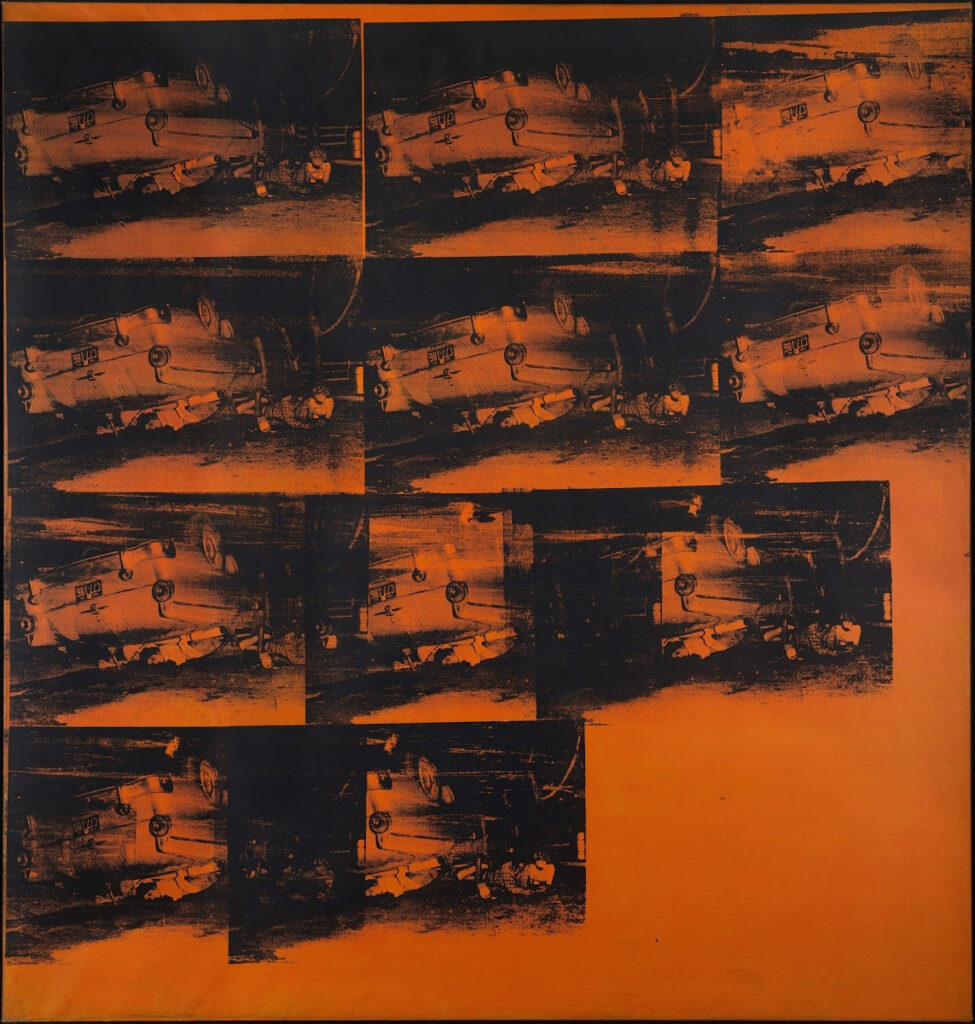
In Warhol’s Disaster series, we encounter the radical de-spiritualization of death. The flat orange background showing through the transparent photographic reproductions arrests attention on the surface: the painting is formally and connotatively shallow. Repetition transforms the image into visual noise. The combination of black and burnt orange make it one the handsomest Disasters Warhol produced.
Warhol’s work conveys the profanation of the world by reproducing reproduction. This device has long since become a cliché and later appropriations, including Warhol’s own, are sterile iterations of an exhausted trope that stretch ironic depthlessness well-beyond its filmic range (which Duchamp had declared to be “infrathin”). That moment when art could put a frame around the banal came and went very quickly. It didn’t really last beyond the ’60s. What we start seeing emerging in the ’70s is what is in full effect today: the effort to re-moralize art by making it a platform for suburban liberal pieties, which has inexorably reduced contemporary art to the performative dimensions of a Twitter post.