Shitshow
Consciousness of a real and meaningful world is intimately connected with the discovery of the sacred. Through experience of the sacred, the human mind has perceived the difference between what reveals itself as being real, powerful, rich, and meaningful and what lacks these qualities, that is, the chaotic and dangerous flux of things, their fortuitous and senseless appearances and disappearances. . . . In short, the ” sacred” is an element in the structure of consciousness and not a stage in the history of consciousness. On the most archaic levels of culture, living, considered as being human, is in itself a religious act, for food-getting, sexual life, and work have a sacramental value. In other words, to be—or, rather, to become—a man signifies being “religious.”
—Mircea Eliade, A History of Religious Ideas
Art has always served power but in the premodern period, power, though associated with wealth, was not its product. Modern power, however, is wholly the power of capital. And the power of capital, unlike the power of nobility or the power of the sacred, is a power that art is hard-pressed to exalt.
Thus, the real story of modern art, once one gets past the self-heroicizing bluster of the avant-garde, is the story of the difficulties that had to be surmounted before art could be sufficiently debased to serve capital.
For art to serve capital, it had to develop the means to make grossness glamorous.
What is grossness? It is the transactional liquidation of all discrimination. This is the enormity that modernity introduced into the aesthetic field, this radical relativization imported into art from the logic of a capitalism that does not recognize any value other than the monetary. Once this idea prevails, the banality of contingency invades both life and art. Grossness is the excrementalizing effect of contingency, the homogenization into waste production of all production since under this regime where all value is determined by price and nothing is of intrinsic value, all meaning is fugitive and provisional and every object and idea disposable.
In this context, the artistic “subversion” of established aesthetic norms and standards is actually a coping mechanism because it is an effort to will the inevitable, to give to what has already happened and is irreversible the appearance of a deliberate “progressive” ground-breaking innovation.
Modern (and postmodern) blasphemous artistic gestures merely perform as willful activism a dismantling of categories that have already been fatally destabilized, already invaded and devoured by the dissolving power of capital, which as Marx had wryly observed in his early writings makes possible “the fraternisation of impossibilities.”
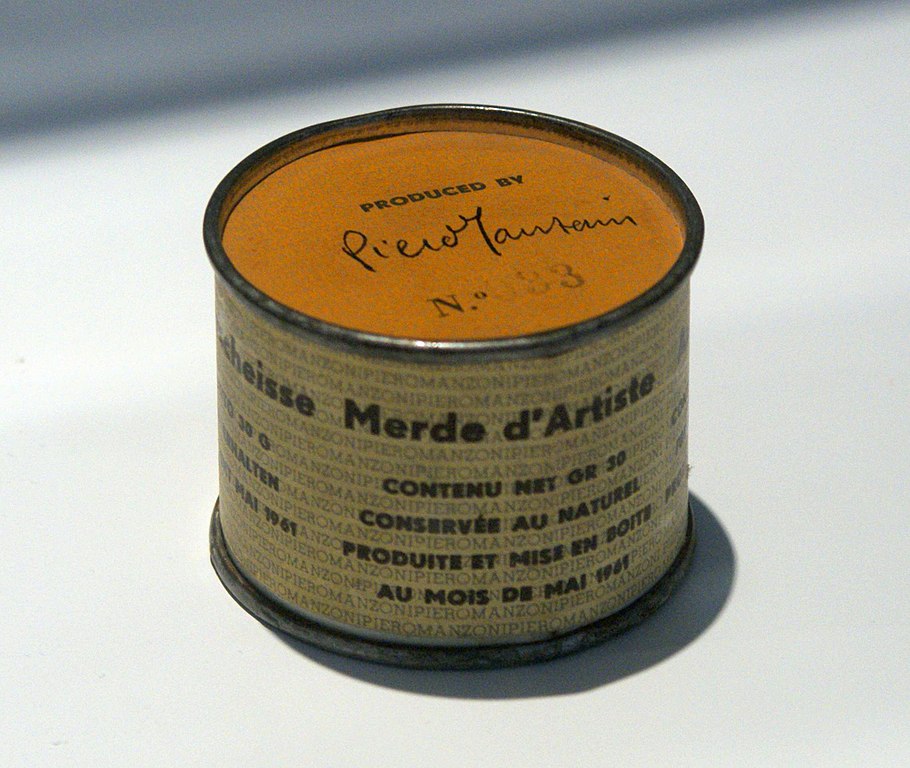
Art in the service of capital is art in the service of shit or what Clement Greenberg politely called kitsch.
The avant-garde rationalized this submission of art to the excrementalizing exigencies of capital by giving it the cover of a programmatic unification of art and “life.”
But what precisely did this unification of art and life entail?
In 1969, on the occasion of the seminal exhibition Live In Your Head: When Attitudes Become Form, Scott Burton blurted out the implications: “Art has been veritably invaded by life,” he declared, “if life means flux, change, chance, time, unpredictability.” Left unsaid was that life comes to mean flux, change, chance, time, and unpredictability only when it has been thoroughly profaned and reduced to mere existence, that is to say when life has become senseless.
So the invasion of art by life comes to mean from the late ’60s onward the transformation of art into a mirror of all the self-perpetuating afflictions of a senseless life: the manic novelty seeking, the compulsive posturing, the pity partying, the attitudinizing, the politicization of trivialities, the simultaneous solicitation of outrage and affirmation, the obsessive preoccupation with identity and its precious signifiers.
The shitshow that is late capitalism is no longer hidden from view. Art doesn’t attempt to offer a refuge from it. It ironicizes it and puts it behind an almost imperceptible transparent wall. Everything becomes a readymade and to that extent, everything becomes a work of art toward which we assume, as Duchamp did, a studied or affected indifference. This is how art serves power today, not by aggrandizing it but by putting a stupid smirk on our faces.