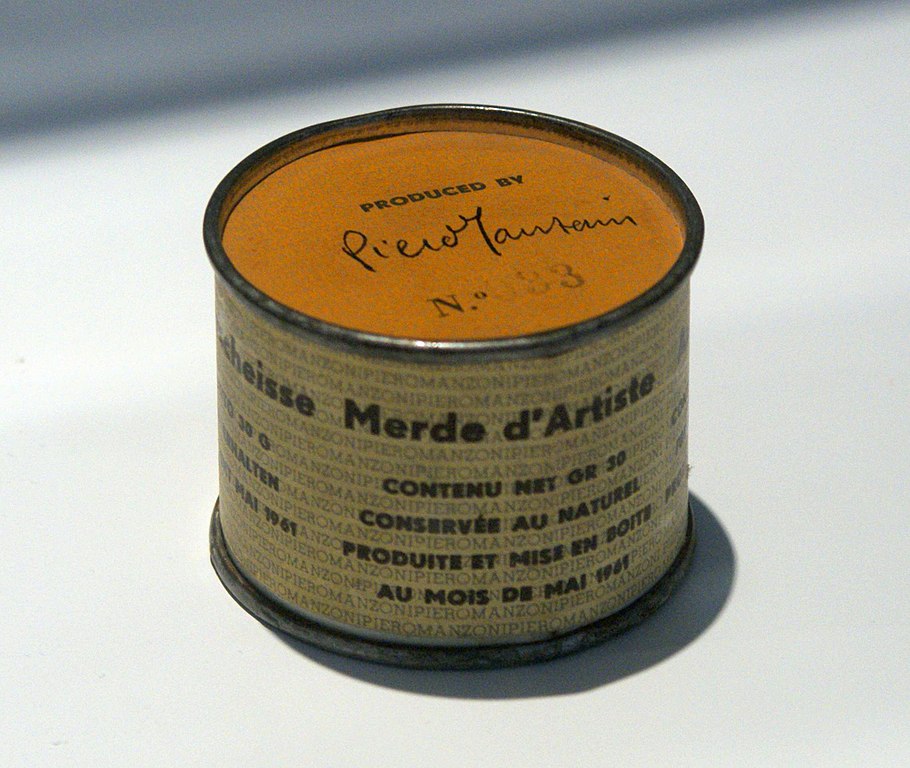
Shitshow

Piero Manzoni, Artist’s Shit, 1961

Consciousness of a real and meaningful world is intimately connected with the discovery of the sacred. Through experience of the sacred, the human mind has perceived the difference between what reveals itself as being real, powerful, rich, and meaningful and what lacks these qualities, that is, the chaotic and dangerous flux of things, their fortuitous and senseless appearances and disappearances. . . . In short, the ” sacred” is an element in the structure of consciousness and not a stage in the history of consciousness. On the most archaic levels of culture, living, considered as being human, is in itself a religious act, for food-getting, sexual life, and work have a sacramental value. In other words, to be—or, rather, to become—a man signifies being “religious.”

—Mircea Eliade, A History of Religious Ideas

Art has always served power but in the premodern period, power, though associated with wealth, was not its product. Modern power, however, is wholly the power of capital. And the power of capital, unlike the power of nobility or the power of the sacred, is a power that art is hard-pressed to exalt.

Thus, the real story of modern art, once one gets past the self-heroicizing bluster of the avant-garde, is the story of the difficulties that had to be surmounted before art could be sufficiently debased to serve capital.

For art to serve capital, it had to develop the means to make grossness glamorous.

What is grossness? It is the transactional liquidation of all discrimination. This is the enormity that modernity introduced into the aesthetic field, this radical relativization imported into art from the logic of a capitalism that does not recognize any value other than the monetary. Once this idea prevails, the banality of contingency invades both life and art. Grossness is the excrementalizing effect of contingency, the homogenization into waste production of all production since under this regime where all value is determined by price and nothing is of intrinsic value, all meaning is fugitive and provisional and every object and idea disposable.

In this context, the artistic “subversion” of established aesthetic norms and standards is actually a coping mechanism because it is an effort to will the inevitable, to give to what has already happened and is irreversible the appearance of a deliberate “progressive” ground-breaking innovation.

Modern (and postmodern) blasphemous artistic gestures merely perform as willful activism a dismantling of categories that have already been fatally destabilized, already invaded and devoured by the dissolving power of capital, which as Marx had wryly observed in his early writings makes possible “the fraternisation of impossibilities.”

Art in the service of capital is art in the service of shit or what Clement Greenberg politely called kitsch.

The avant-garde rationalized this submission of art to the excrementalizing exigencies of capital by giving it the cover of a programmatic unification of art and “life.”

But what precisely did this unification of art and life entail?

In 1969, on the occasion of the seminal exhibition Live In Your Head: When Attitudes Become Form, Scott Burton blurted out the implications: “Art has been veritably invaded by life,” he declared, “if life means flux, change, chance, time, unpredictability.” Left unsaid was that life comes to mean flux, change, chance, time, and unpredictability only when it has been thoroughly profaned and reduced to mere existence, that is to say when life has become senseless.

So the invasion of art by life comes to mean from the late ’60s onward the transformation of art into a mirror of all the self-perpetuating afflictions of a senseless life: the manic novelty seeking, the compulsive posturing, the pity partying, the attitudinizing, the politicization of trivialities, the simultaneous solicitation of outrage and affirmation, the obsessive preoccupation with identity and its precious signifiers.

The shitshow that is late capitalism is no longer hidden from view. Art doesn’t attempt to offer a refuge from it. It ironicizes it and puts it behind an almost imperceptible transparent wall. Everything becomes a readymade and to that extent, everything becomes a work of art toward which we assume, as Duchamp did, a studied or affected indifference. This is how art serves power today, not by aggrandizing it but by putting a stupid smirk on our faces.
The Prison of Rights

“Initiation usually comprises a threefold revelation of the sacred, of death, and of sexuality.” (Mircea Eliade, The Sacred and the Profane)The initiate emerges from the initiating mysteries as one who knows. 

The symbolism of death and (re)birth figures prominently in these mysteries. The initiatory ordeals impress upon initiates the import of coming to age and gaining admission into a society of recognized adults. The painful ordeals make the passage an indelible experience but also convey the existential weight of the secret knowledge that is revealed to the initiate. Knowledge of what is vital is knowledge of pain but also knowledge of the ability to surmount pain and deprivation. Thus the initiate gains both self-confidence and pride in tribal fellowship. The necessary subjugation that forges fully formed subjects is not left to chance.

In a desacralized society, the symbolism of death and birth is unavailable, as is symbolism in general, and rites of passage no longer exist. This leaves each individual to “choose” his or her own identity, now extended to the right of each individual to declare their gender identity. Because these identities are self-conferred with no travail they carry little weight and are as easily cast off as they are put on. Under these circumstances, identity never amounts to anything more than an attitude and one never attains the position of one who knows. One remains a perpetual infant, not to say an embryo, arrested in a lifelong condition of insecure identity, anxiety, and bewilderment. The young are formally enjoined to “grow up” but they are immersed in a disorder that they do not have the means to escape. Their “rights” confine them for a lifetime in a larval stage of boundless but never realized potential.

Religious man conquers the fear of death and acquires the ability to live fully and authentically by assigning death the symbolic meaning of passage: initiation kills the profane and unformed man, who is then reborn as consecrated man, free from the fear of death and, therefore, enabled to live a noble life. Uninitiated, irreligious man shrinks from death and is, therefore, condemned to live a cowardly, compromised, senseless half-life.

This has bearing on why the West is at war with itself and takes pride in demolishing its own traditions, canons, and monuments. A desacralized and diminished civilization cannot tolerate the memory of its sacred origin. The legacy of the past becomes an embarrassing encumbrance putting to shame the spiritual poverty of the present.  But the willful erasure of the past does not prevent it from haunting the present. The sacred persists as a haunting, as the always possible undoing of “progress.”

The End of Art

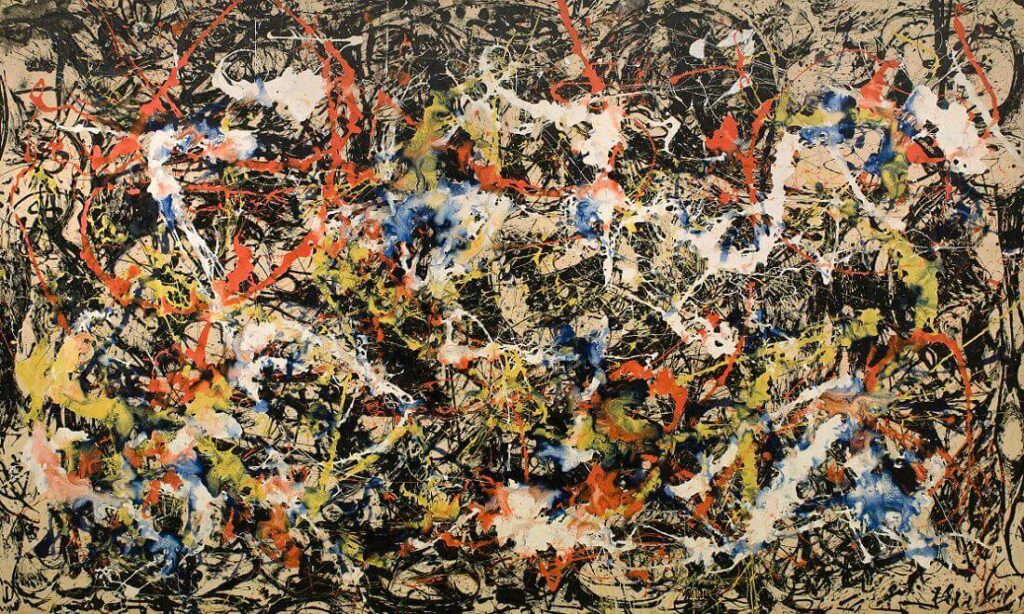
Jackson Pollock, Convergence, 1952

Art originated as a means of representing the sacred. It originated to make visible what cannot be seen, to represent what is unrepresentable.

As long as art served the sacred, it had purpose and vitality.

The modern profanation of life and society left art flailing for a purpose. Oscar Wilde went so far as to declare the uselessness of art to be its distinguishing virtue. He was forced to do so to safeguard art from serving an even viler purpose, the worship of money. But art was not content to be useless and has since been driven to stage its own degradation as its purpose, incorporating into itself everything that was once foreign to it: ugliness, banality, artlessness, blasphemy. 

In this fallen world, the pull of the sacred lingers as an inclination toward the abyss. The closest to sacred art today is art that expresses a longing for self-extinction. What comes to mind is music that inspires trance and abandon.

In visual art, the ecstatic is misidentified as “expressionism,” but the truly ecstatic art is always about the obliteration of the self not its expression.

Theatricalities

Modernism does not eschew theatricality. It is hostile to a certain kind of theatricality, the theatricality of the ancien régime, the theatricality of sentiment and the picturesque. This is at the root of the idea of banishing “illusionism.”

Modernist theatricality is the theatricality of realism.

Realism is deceptive because it poses as something like honesty, as disdain for theatricality. But the real that realism constructs is as much a fiction as the scenic or the picturesque.

So modernist theatricality is a theatricality of honesty, the staging of unstaginess. And yet, it yields very odd, very stilted results. This is already evident in Cezanne, particularly, in his Bathers. Every mark in the painting reveals itself as mark and the surface as remorselessly flat but the bodies and faces of the bathers suffer mutilations prefiguring those that will appear with greater cruelty in Picasso’s Demoiselles.

Postmodernist theatricality is a late-stage inversion of norms. The labored modernist upendings of ancien régime artistic conventions have been academicized to the point where a systemic perversity becomes the deadening norm. So everything formerly bad becomes good in a thoroughly institutionalized way.

Alfred Jarry once observed that an anarchist army could be just as disciplined as any other: The anarchist sergeant just has to bark “Left turn!” and the anarchist soldiers crisply pirouette to the right.

Postmodernist theatricality is the theatricality of a surrender to the imperatives of consumerism staged to look like licentious, anarchic excess, something Deleuze and Guattari in their own frenzied Oedipal effort to bugger Freud failed miserably to understand. The consumer is, indeed, a “desiring machine.” That is what capitalism has reduced him to and like Senatspräsident Schreber this desiring machine can, within the confines of its Matrix-like hallucinatory cocoon, cultivate limitless but inconsequential perversities because its machinic desire is the charge that animates the greater, enclosing machine that is capitalism, of which the hapless schizo consumer is but a dumb cog. In other words, postmodernism is the theatricality of a “counterculture” mesmerized, like the vagabond couple in Antonioni’s Zabriskie Point, by the coyness of disaffection.

No doubt, there are other types of theatricality. I don’t think theatricality in itself has any bearing on the validity of any type of art.

When he wrote “Art and Objecthood,” Michael Fried was grasping at straws. Yes, Judd’s and Morris’ and most of Smithson’s output was vacuous, but it should have been possible to say this without the tortured invoking of theatricality as the reason for its vacuity. Fried , however, wanted to denounce the banality of formalism’s inevitable progression into “literalism” without abandoning the sterile formalist criteria he inherited from Greenberg, criteria that were sterile not because form is unworthy of care but because Greenberg, in his effort to oppose kitsch with his anemic version of modernism, reduced formalism to a mechanistic “entrenchment” of “competence” that solicited nothing but straining after minute technical innovations.

A cogent argument against literalism would have required from Fried a declaration that art is essentially symbolic and cannot be reduced to a dumb thing. Art’s fundamental relationship is with the sacred. Throughout “Art and Objecthood” you can see Fried sidle up to acknowledging that art is spiritual without, however, being able to openly say so.

What stopped him?

I believe it was two things: a formalism fixated on “opticality” that foreclosed any acknowledgment of what in art transcends eye candy, and, related to this, the sheepishness that afflicts any critic who needs to preserve an aura of modern, therefore agnostic, sophistication and eschew vulnerability to “mystical” ideas. And yet we know that at its origin, formalism was expressly formulated by Mallarmé and others as a refuge for what remained of the sacred in a world overwhelmed by crass materialism and the bourgeois instrumentalization (and excrementalization) of everything.

Fried’s problem was that he was trying to stave off the final step in the degeneration of a formalism already desacralized by Greenberg. By the time Fried intervened to arrest its slide into total banality, formalism was beyond redemption, and his only recourse was to propose as alternative to the vacuity of Donald Judd the vacuity of Anthony Caro.

Theatricality is the least of art’s faults. When art loses its once-sacred purpose, it itself becomes an agent of spiritual degradation. This is the truth that Fried could not speak.

The Sacred and the Readymade

In a desacralized world, the sacred persists, tenuously, as the aesthetic. Therefore, the work of sacralizing the world becomes an effort to aestheticize it. Paradoxically, this is why the banal comes to dominate art from Dada onwards. A great deal of what seems like provocation is a test of art’s sacralizing capability, that is to say, a test of art’s ability to aesthetically redeem the least aesthetically promising material. The artists themselves may not understand what they are doing. Vapid claims of transgression may surround and obscure their efforts. But the appropriation of the banal is a last-resort form of aestheticization, a limit case. The readymade snatches the ordinary out of ordinariness and makes it imperceptibly singular. So the readymade becomes, effectively, the closest postmodern analogue of the sacred object.

Scroll to Top