My Current Motto
I should be looking for beauty not arguing with ugliness.
Anyone whose overriding craving is for power cannot enjoy art because art is humbling not empowering. The experience of art is similar to the experience of the sacred: it demolishes the ego, it kicks your feet from under you. Like religion, which art faithfully served from the moment of their entwined origin, art is a means of transport.
There is no question that in order for canons to be renewed they must at various intervals be upended. But that upending must be at the hands of newer, more vigorous artists whose destructive gestures release a living tradition from the dead encrustations strangling it. Academic canon-busting is something else altogether because it issues from a neurotic hatred of what the bureaucratic intellect cannot apprehend or circumscribe.
Art survives now by disguising itself as something too dumb to be taken seriously.
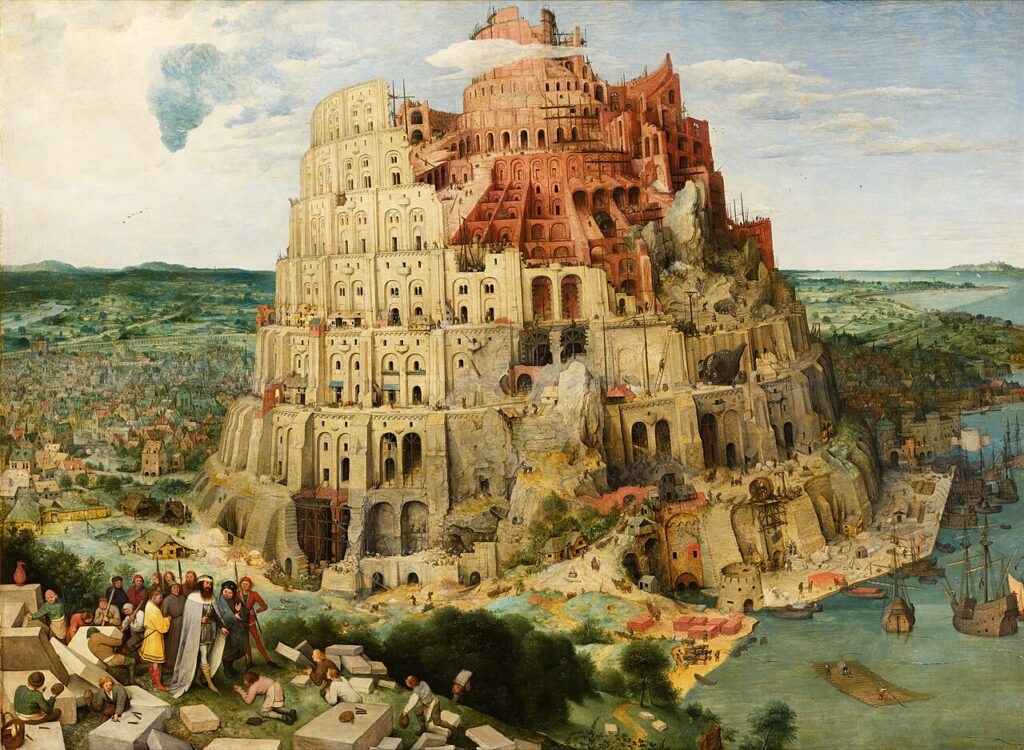
The story of the Tower of Babel should be understood as a story about the foolishness of attempting to achieve metaphysical elevation by physical means.
Transhumanism is another Tower of Babel. Technology cannot grant transcendence.
Becoming superhuman, becoming shaman, is a process of subtraction not addition. It is an ordeal. To become spirit, the prospective shaman must first experience death. Only then can he visit the heavens and the underworld. Cyborgs cannot do this.
As I start my severely restricted internet diet, some thoughts.
Media is fundamentally evil. The “news,” whatever the source, trains you to be passive. What others are doing/deciding takes precedence. You are just a spectator.
The world seen through media is an inversion of your existence. You should be absorbed in the the things that you can and should manage. You should be attentive to and deriving satisfaction from mindfully doing everyday things like making a meal, taking a walk, or playing with the dog. Or just breathing. These are the important things. But instead, you are caught up and vicariously living off the drama purveyed by media, which solicits your opinion about everything.
Of course, you do this because you want to escape from the mundane. But there is a feedback loop here, as in all addictive behavior. You want to escape the mundane because your exposure to media has desacralized and diminished the mundane. You have been seduced by the idea that the big reality is over there, in the virtual space of online chatter. Your own immediate sensations and surroundings have been emptied of significance. The immediate has become unreal. You recoil from it. You treat it with contempt. The immediate is an encumbrance you must shed so you can focus on the real issues of the day, which are whatever it is that agitates the social media mobs. Social media immerses you in the imaginary. You regress into the hysteria of identification. (All talk about what you identify as is just that, hysteria. In a sane society, you are what you do, i.e. what makes you useful to others, not what you hallucinate.)
Once your contact with the immediate is broken, your craving for the mediated intensifies exponentially. People talk about porn addiction. But addiction to porn is merely the most garish form of addiction to media. Porn is the ultimate form of hysterical sexuality, where imaginary relations have completely displaced actual social intercourse. But the idolatry of the imaginary (and the corresponding devalorization of the immediate) is the essence of media spectacle in general. Mass media is mass onanism. Everybody on social media is jerking off.
Media critique, an obsessive academic practice, does not address this problem. It amplifies it, adding chatter to chatter.
To regain any kind of autonomy and respect for your own authentic way of being in the world, a radical disengagement from media is necessary. You have to impose a strict purge. Meditation helps. It makes you aware of how much foam there is in your head, how much of what you think of as self is a tissue of knee-jerk responses to media provocations. Taking a “position” on every media-fabricated event is how you condemn yourself to a lifetime of impotence.
I’m not interested in the manic pursuit of (pseudo)novel form. For me it is enough that something—even something that started as an infatuation—turns into a trend to become gross and despicable. The mania for novelty subsumes great deal of what passes for contemporary art into an abject sub-genre of crass consumerism pandering to the vapid appetites of hedge fund managers.
Beauty is not the same thing as eye candy.
For the relatively brief period when abstraction cast a spell, it was because it expressed a desire for transcendence. A desacralized abstraction is of no interest to me. For eye candy, you’re better off going to the mall.
I’m interested in poetic form, form anchored in a symbolic universe. Ideally, it should be form that in some way, perhaps in a very subtle way, engages with traditional forms.
I am drawn to repetition, but repetition can mean different things in different contexts. In Warhol it means banality. The repetition that interests me is the repetition found in rhythm, song, and prayer.
I discovered poetry through the Surrealist poets and their idea of the marvelous. Nowadays I’m more at home reading Cavafy. In any case, the thing that I discovered in poetry is the magic of words. We use words all the time. They are a debased currency. But in poetry (and song) words become mystical incantations. They produce vibrations that transport the soul to heaven.
Art is a step toward ecstasy.