Bananas

The Dadaist breakdown of the distinction between “art” and “nonart,” and the subsequent mutation of Dada into Pop did not “democratize” art. It magnified the power of the institutional gatekeepers. When someone duct-tapes a banana to a wall and calls it art, validation depends on the assent of these high-placed arbiters. Such gestures have always been expressly designed to offend common sensibility. Antiart manufactures uncommon art. The purpose of uncommon art is to make its consumers feel uncommon. It is no coincidence that Warhol’s arrival coincided with the arrival of the hipster and what Miles Davis called the birth of the cool.

The myth of an anti-bourgeois avant-garde hides the collusion of the avant-garde with its bourgeois patrons to create a new class of luxury goods with no intrinsic value other than their snob appeal. The very notion of an avant-garde was always misleading. The avant-garde did not lead, it followed. It supplied what the bourgeoisie, a new upstart class, needed to mark its cultural ascent.

When the bourgeoisie was revolutionary and heroic, avant-garde art was revolutionary and heroic. When the bourgeoisie degenerated and spawned feckless ninnies, the avant-garde degenerated with it. We call this postmodernism.

Wasteland

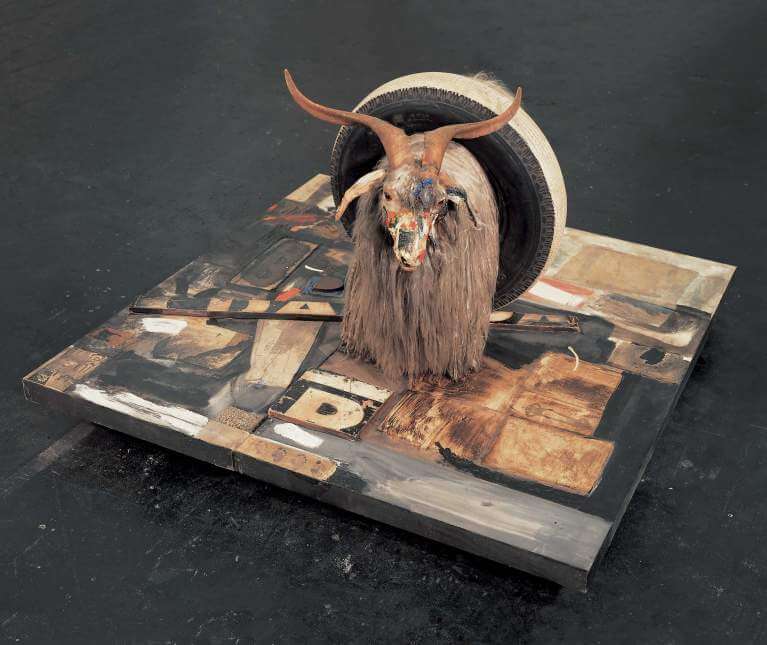
Robert Rauschenberg, Monogram, 1955-59

When what were formerly existentially significant modes of being in the world are reduced to “lifestyles,” then a postmodern diversity does indeed become possible. For then everything can coexist with everything without generating conflict or tension in the same way that the corpses of men who were enemies in life can happily coexist in a cemetery. 

In art, Rauschenberg’s Combines embody this enervated diversity of used-up dead things.  If we could all play dead, we would be able to get along as fabulously as the stuffed goat and the tire.

Disaster

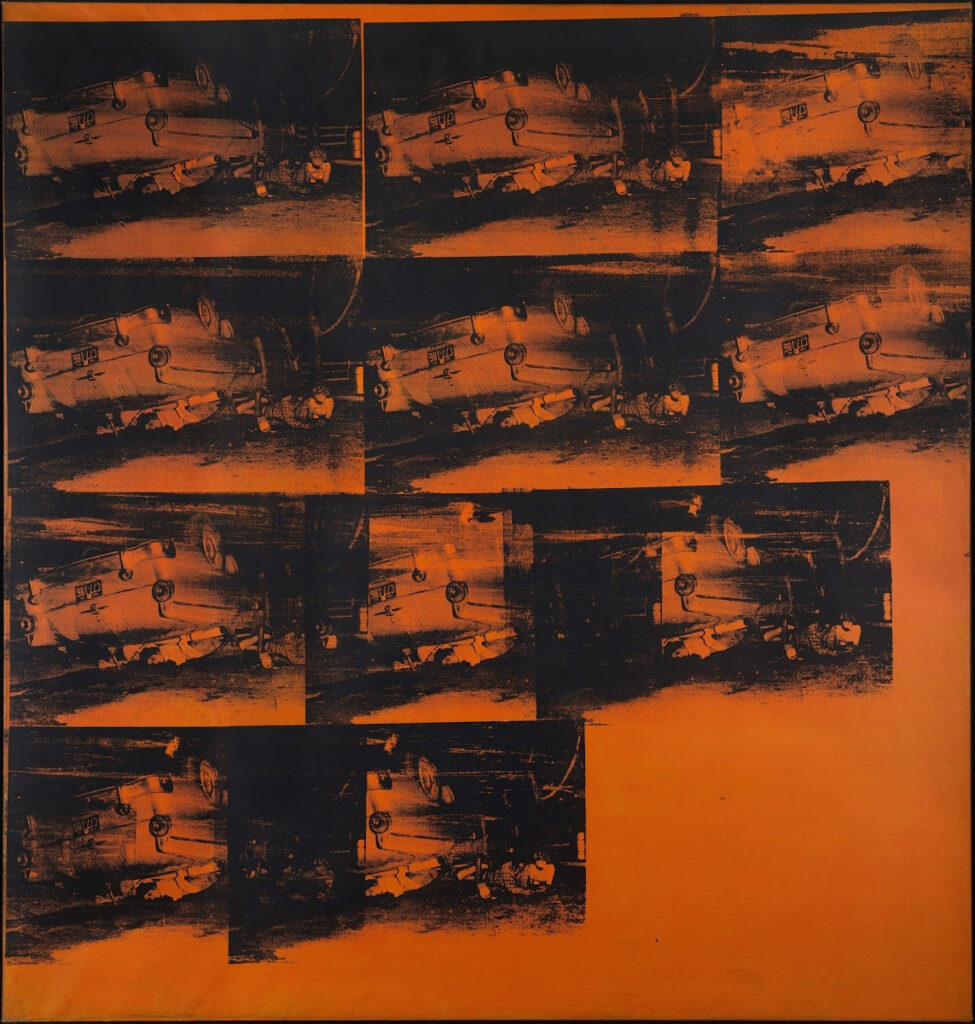
Andy Warhol, Orange Car Crash (5 Deaths 11 Times in Orange) (Orange Disaster), 1963 

 It is as a further result of his ability to travel in the supernatural worlds and to see the superhuman beings (gods, demons, spirits of the dead, etc.) that the shaman has been able to contribute decisively to the knowledge of death. In all probability many features of “funerary geography,” as well as some themes of the mythology of death, are the result of the ecstatic experiences of shamans. The lands that the shaman sees and the personages that he meets during his ecstatic journeys in the beyond are minutely described by the shaman himself, during or after his trance. The unknown and terrifying world of death assumes form, is organized in accordance with particular patterns; finally it displays a structure and, in course of time, becomes familiar and acceptable. In turn, the supernatural inhabitants of the world of death become visible; they show a form, display a personality, even a biography. Little by little the world of the dead becomes knowable, and death itself is evaluated primarily as a rite of passage to a spiritual mode of being. In the last analysis, the accounts of the shamans’ ecstatic journeys contribute to “spiritualizing” the world of the dead, at the same time that they enrich it with wondrous forms and figures.

—Mircea Eliade, Shamanism

In Warhol’s Disaster series, we encounter the radical de-spiritualization of death. The flat orange background showing through the transparent photographic reproductions arrests attention on the surface: the painting is formally and connotatively shallow. Repetition transforms the image into visual noise. The combination of black and burnt orange make it one the handsomest Disasters Warhol produced.

Warhol’s work conveys the profanation of the world by reproducing reproduction. This device has long since become a cliché and later appropriations, including Warhol’s own, are sterile iterations of an exhausted trope that stretch ironic depthlessness well-beyond its filmic range (which Duchamp had declared to be “infrathin”). That moment when art could put a frame around the banal came and went very quickly. It didn’t really last beyond the ’60s. What we start seeing emerging in the ’70s is what is in full effect today: the effort to re-moralize art by making it a platform for suburban liberal pieties, which has inexorably reduced contemporary art to the performative dimensions of a Twitter post.

Tripping

The derealization of the world becomes acute from the ’60s onward.

Not because of drug use. Drug use is a symptom of a receding world and of a facile (chemical) attempt to reestablish connection with something beyond trite appearance.

The paradox is that scientific “evidence-based” knowledge diminishes rather than increases contact with reality. When physics supplants metaphysics, the world is emptied of meaning, becomes insubstantial. Science zombifies world, turns it into dead minutiae.

Consumerism turns the world into an array of disposable things and images. Disposability contributes to the sense that “nothing is real.”

Photography and photographic media promise a forensic intimacy with reality but transform reality into fleeting images.

The social sciences demythify the world. This demythified world shatters into fragments experienced in bewildering isolation from each other. (Christopher Nolan’s Memento.)

In this shattered world, “identity” becomes a fetish. 

Unable to participate in a shared, consecrated reality, the postmodern subject becomes a consumer of selfhood, buying into one identification after another and declaring the assortment at every possible opportunity in a frenzy of self-reification. But instead of feeling grounded, this overdefined subject suffers from imposter syndrome. 

The derealization of the world and the self are complementary. They are the two sides of the current mass psychosis.

Theatricalities

Modernism does not eschew theatricality. It is hostile to a certain kind of theatricality, the theatricality of the ancien régime, the theatricality of sentiment and the picturesque. This is at the root of the idea of banishing “illusionism.”

Modernist theatricality is the theatricality of realism.

Realism is deceptive because it poses as something like honesty, as disdain for theatricality. But the real that realism constructs is as much a fiction as the scenic or the picturesque.

So modernist theatricality is a theatricality of honesty, the staging of unstaginess. And yet, it yields very odd, very stilted results. This is already evident in Cezanne, particularly, in his Bathers. Every mark in the painting reveals itself as mark and the surface as remorselessly flat but the bodies and faces of the bathers suffer mutilations prefiguring those that will appear with greater cruelty in Picasso’s Demoiselles.

Postmodernist theatricality is a late-stage inversion of norms. The labored modernist upendings of ancien régime artistic conventions have been academicized to the point where a systemic perversity becomes the deadening norm. So everything formerly bad becomes good in a thoroughly institutionalized way.

Alfred Jarry once observed that an anarchist army could be just as disciplined as any other: The anarchist sergeant just has to bark “Left turn!” and the anarchist soldiers crisply pirouette to the right.

Postmodernist theatricality is the theatricality of a surrender to the imperatives of consumerism staged to look like licentious, anarchic excess, something Deleuze and Guattari in their own frenzied Oedipal effort to bugger Freud failed miserably to understand. The consumer is, indeed, a “desiring machine.” That is what capitalism has reduced him to and like Senatspräsident Schreber this desiring machine can, within the confines of its Matrix-like hallucinatory cocoon, cultivate limitless but inconsequential perversities because its machinic desire is the charge that animates the greater, enclosing machine that is capitalism, of which the hapless schizo consumer is but a dumb cog. In other words, postmodernism is the theatricality of a “counterculture” mesmerized, like the vagabond couple in Antonioni’s Zabriskie Point, by the coyness of disaffection.

No doubt, there are other types of theatricality. I don’t think theatricality in itself has any bearing on the validity of any type of art.

When he wrote “Art and Objecthood,” Michael Fried was grasping at straws. Yes, Judd’s and Morris’ and most of Smithson’s output was vacuous, but it should have been possible to say this without the tortured invoking of theatricality as the reason for its vacuity. Fried , however, wanted to denounce the banality of formalism’s inevitable progression into “literalism” without abandoning the sterile formalist criteria he inherited from Greenberg, criteria that were sterile not because form is unworthy of care but because Greenberg, in his effort to oppose kitsch with his anemic version of modernism, reduced formalism to a mechanistic “entrenchment” of “competence” that solicited nothing but straining after minute technical innovations.

A cogent argument against literalism would have required from Fried a declaration that art is essentially symbolic and cannot be reduced to a dumb thing. Art’s fundamental relationship is with the sacred. Throughout “Art and Objecthood” you can see Fried sidle up to acknowledging that art is spiritual without, however, being able to openly say so.

What stopped him?

I believe it was two things: a formalism fixated on “opticality” that foreclosed any acknowledgment of what in art transcends eye candy, and, related to this, the sheepishness that afflicts any critic who needs to preserve an aura of modern, therefore agnostic, sophistication and eschew vulnerability to “mystical” ideas. And yet we know that at its origin, formalism was expressly formulated by Mallarmé and others as a refuge for what remained of the sacred in a world overwhelmed by crass materialism and the bourgeois instrumentalization (and excrementalization) of everything.

Fried’s problem was that he was trying to stave off the final step in the degeneration of a formalism already desacralized by Greenberg. By the time Fried intervened to arrest its slide into total banality, formalism was beyond redemption, and his only recourse was to propose as alternative to the vacuity of Donald Judd the vacuity of Anthony Caro.

Theatricality is the least of art’s faults. When art loses its once-sacred purpose, it itself becomes an agent of spiritual degradation. This is the truth that Fried could not speak.
Scroll to Top